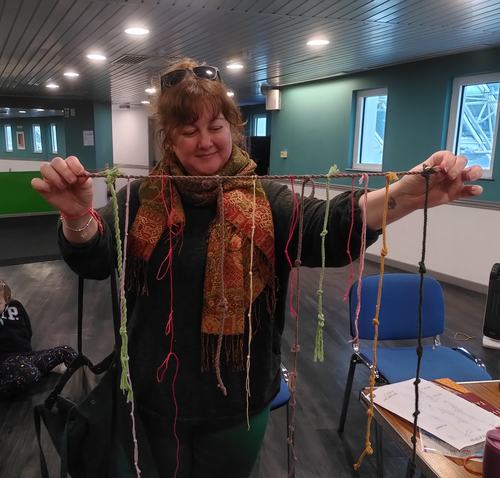
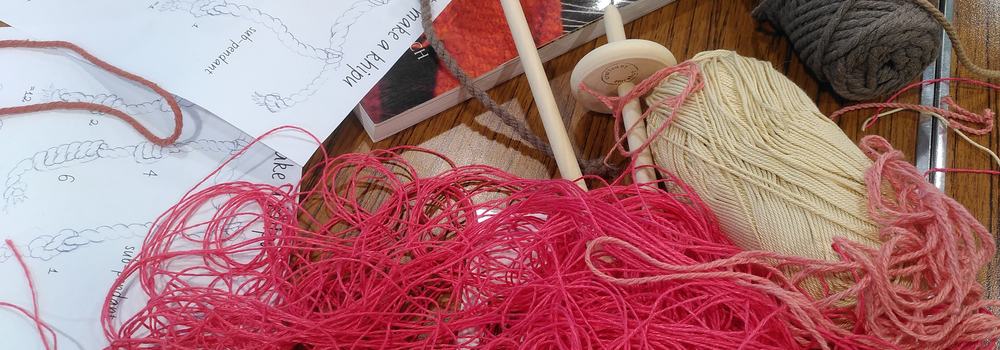
The Poly, in Falmouth is a local institution with a long history, starting in 1833 to promote arts and sciences in a time before we saw such a hard separation between these fields. They wanted us to provide a workshop for a pop up event they were doing in the Pendennis Community Centre, a community owned location, accessible for workshops for families.
We thought our Andean khipu and woven robots activities might be a good fit - it was interesting to do this in a local place, as previously we have only done this further afield! The activities we set up included:
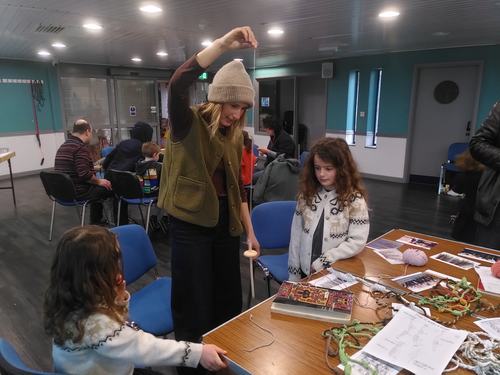
- Khipu making, plying and knot making - lots of different type of yarn, drop spindles, an example khipu (made from the alpaca accounts!) and drawn explanation of the different knots involved
- Pluggable knots and woven robots, mostly to be used unsupervised
- The tablet loom, warped up and ready to use (with the Hallstatt braid)
- Plenty of contextual information, such as photos of Inca life, maps of the region showing its history, current use of khipu in Tupicocha (where they are used as a symbol of trust of their community by elected representatives) and in the work of Paola Torres Núñez del Prado, who explores khipu as an art form and in performances to make music
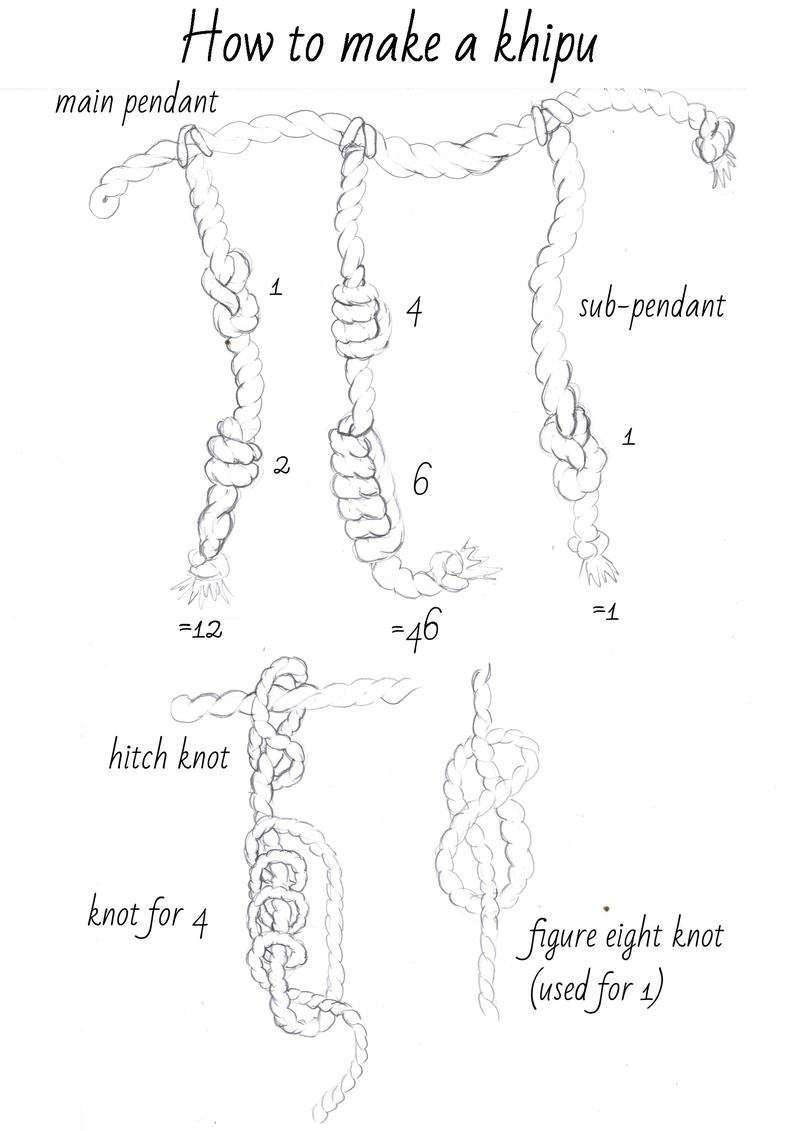
It is frustrating that so many illustrations of khipu are prohibitively copyrighted, so we made our own drawing to print out and use for this workshop (CC-BY, if you want to use it yourself). It's a good example of where a drawing is much clearer than a photo to explain how the knots are made and the way to attach your pendants together.
As it worked quite well in Düsseldorf, we set up the pluggable knots and robots as a way to 'break the ice' and get people involved in a way that could be left unsupervised and used in a low pressure way. It also introduces the concept of 'knots meaning things' in a concrete way that doesn't need much further explanation. We did change the way the knots were mapped to the robot movements for this workshop though to make this easier, more detail on that soon.
Doing textile workshops with groups like this where technology is present but backgrounded seems to be important. We are talking about textiles as a technology itself and showing a culture with an extremely long history, but critically a current one too - showing that khipu are as much a part of the 'modern' world as an iPhone is. Having some robots and microcontrollers present, unremarked and entangled in fabric is an attempt to present a continuum from the "tech" and all that we associate with that, alongside the relationship between thought, representation and material in a more general way - to provide more inclusive ways to talk about these concepts.
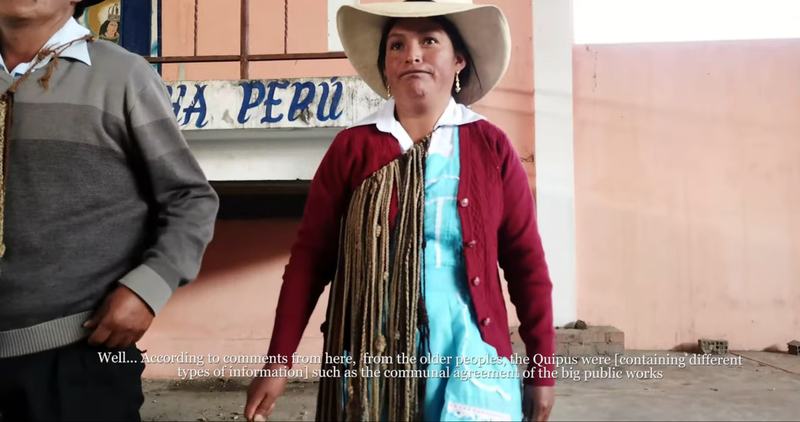
An elected representative in Tupicocha wearing her khipu, still from a documenary made by Paola Torres Núñez del Prado
The workshop really becomes one that is centred on plying thread - using drop spindles, and the magic moment when you release a well twisted yarn and it spins itself into a thicker version. This necessary step, used for centuries to make pendants to build khipu from, choosing the colours you want to mix together, and the possibility of making ever thicker threads with more and more colours is very appealing.
We also took the tablet loom along, and didn't have quite enough time or space to put it out with everything else, so it was sort of hidden to one side. However it was found quite quickly by inquisitive participants, and so at one point we had tablet weaving added to the mix as well. Each family took away their khipu, some of them had been altered into wearable designs - something I suspect happens often in their use across the world.