
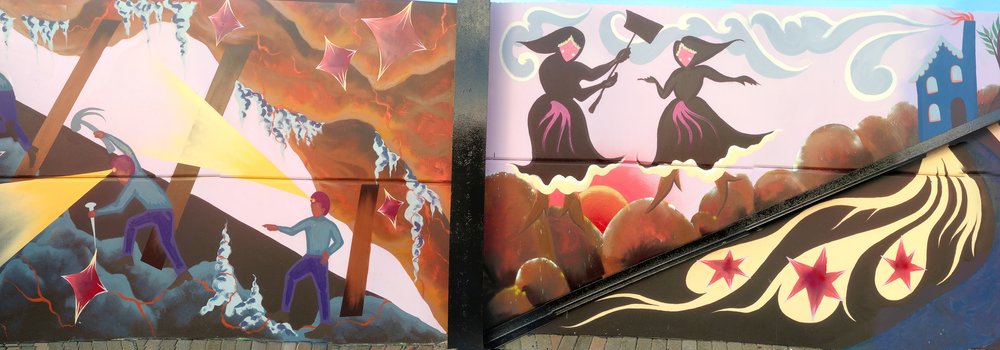
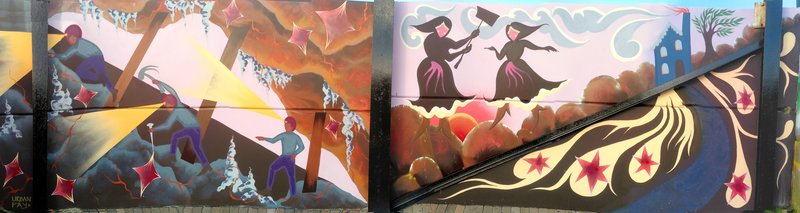
This year we had the opportunity to do a lot of extra activities for the organised atoms project beyond our family workshops. Firstly we wanted to leave something behind related to the project for United Downs Raceway who have been our wonderful hosts for the past two years. We commissioned muralist and illustrator Natasha Watson to design and produce a mural based on the project and the history of Ale and Cakes mine. She took part in one of our workshops as research for the mural, so she had experience of cracking open rocks and finding veins of mineralisation and crystals, and it was interesting to see how this inspired her work, featuring miners, bal maidens, yellow veins of chalcopyrite copper ore, crystals and rocky textures.
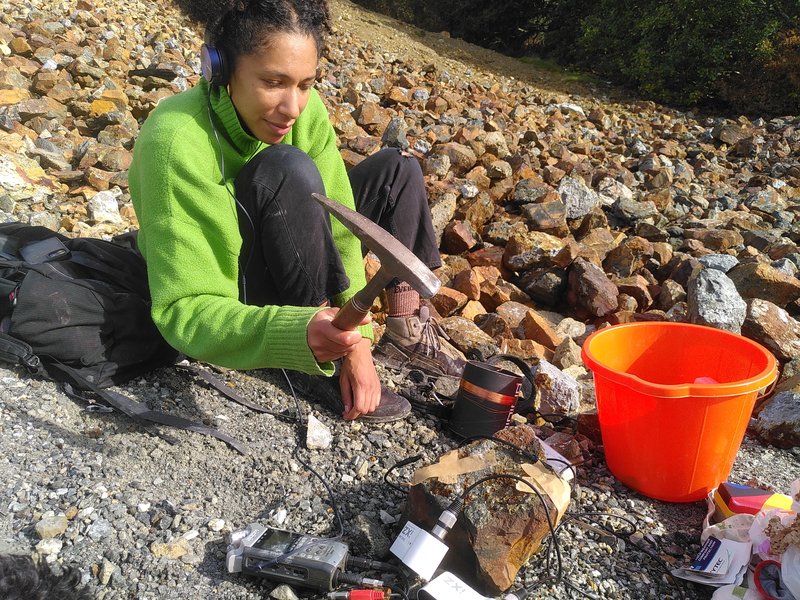
We also had some interest from artists who wanted to find out more about looking for minerals and ways to listen to them. We went to Nangiles mine with Libita Sibungu and took with us contact microphones, an EM coil, loads of recording equipment and the ubiquitous buckets that this project seems to always involve. Nangiles is a relatively recently worked mine, and its a good place to find plenty of quartz and sphalerite and iron, copper and arsenic pyrites in large blocks you can hammer away at, giving us a taste of the skills that the Bal Maidens knew so well. We then had an afternoon in our new studio in Potager garden, collecting microscope images of what we found, and recording them using their semiconducting properties.
Rosanna Martin (who was previously a resident for our collaboration with the Eden Project) came to the Raceway to learn how we've been working with minerals for making sounds. She is running her own site called Brickfield in a disused china clay quarry near St Austell, doing experiments on the ceramic and communal processes involved with brick making. We explored the area around where Natasha was painting her mural and found some interesting things, including a thick vein of pale purple amethyst. Then we went to the 'rock lab' to examine and sonify our finds, and did a little research into the mineralisation present in her site.
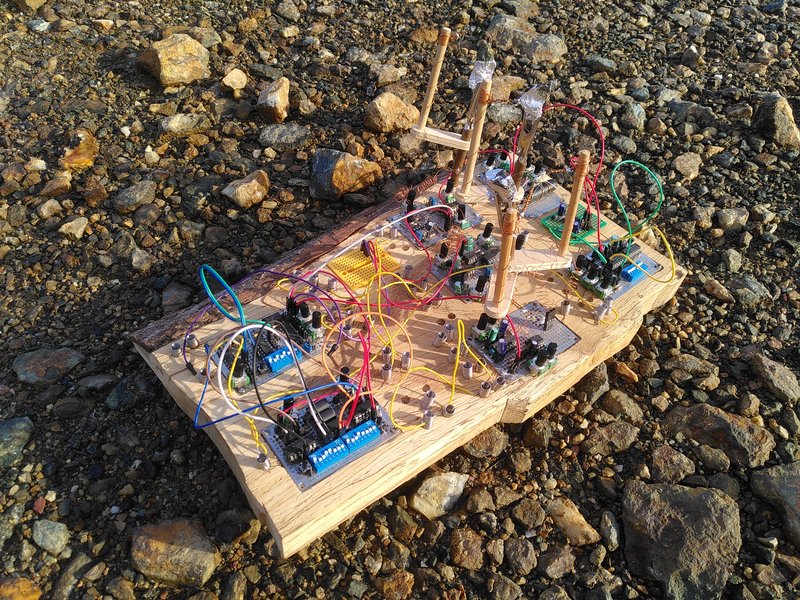
One of the artefacts of this year's organised atoms project has been a new crystal 'log synth', made as a simple and fun way to make music with crystals and combine them with more normal synthesisers, alongside our cardboard kits, and it was well tested by kids (and their parents!) in the workshops this year. We've continued tinkering with this, recording tracks and publishing them online. Each piece of music is linked with the location the crystals were found, a little bit of history and some info about the minerals involved. We thought it might be a good idea to put this on Reddit (Making techno with 270 million year old semiconductors) to get a more international response to this very locally situated project, and it was a bit of a hit, getting 33 thousand views and counting, with a great response in the comments.
The new collaborations, input and exposure that this project has had this year has given us lots of new ideas and directions for what comes next:
- Working on this material in a more performance based manner, hooking into a strong local artistic scene linked with rocks and all things subterranean.
- Developing some of these sound prototypes further, as it seems to be still the case that not many people have experimented with natural semiconductors - in recent times anyway.
- Designing some workshops specifically for musicians and sound artists is also high on the list.
- We also have some exciting new plans with our new collaborators for next year!